Moissanite vs lab diamond: which one should you buy?
Looks like a diamond. Sparkles more. Costs a fraction. That is moissanite: a lab-created gem that bends light more than a diamond and splits it into more rainbow fire, made to last a lifetime of everyday wear. Pick a lab-grown diamond if you want a stone that is actually diamond: calm white sparkle and a grading report.
- Both are hard enough for a lifetime of daily wear, so choose on looks and price.
- Fire (dispersion): moissanite 0.104, diamond 0.044.
- A basic thermal tester reads both as diamond.
- Both are made in a lab. Only one is diamond.
- Expect little money back if you ever sell either.
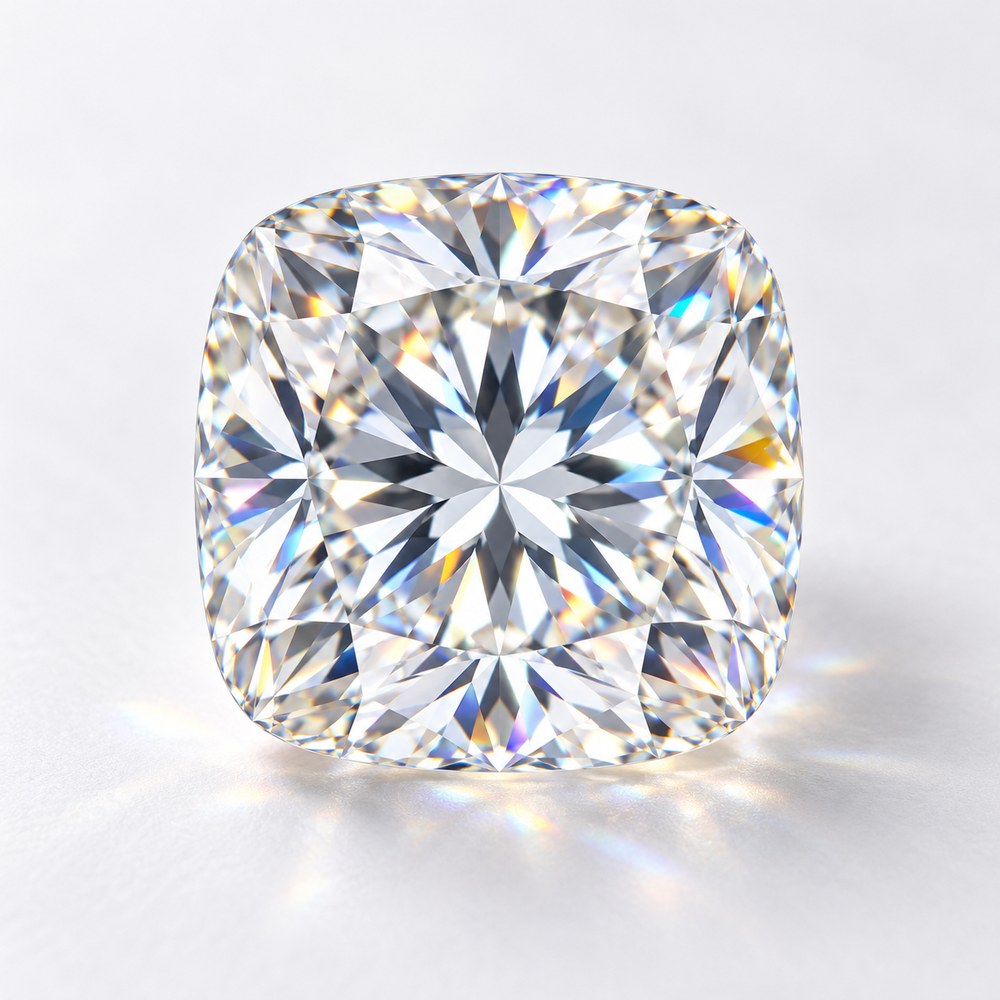
The short version, side by side
Moissanite is silicon carbide. A lab-grown diamond is pure carbon, the same material as a mined diamond, grown in a machine instead of the ground. That one difference drives everything in the table.
| Property | Moissanite | Lab-grown diamond |
|---|---|---|
| Material | Silicon carbide | Carbon (diamond) |
| Refractive index (brilliance) | 2.65 to 2.69 | 2.42 |
| Dispersion (fire) | 0.104 | 0.044 |
| Density (g per cubic cm) | 3.21 to 3.22 | 3.52 |
| Light path | Doubly refractive (facet edges look doubled under a loupe) | Singly refractive |
| Thermal tester | Reads "diamond" | Reads "diamond" |
| Electrical (multi) tester | Reads "moissanite" | Usually "diamond"; some boron-bearing stones read "moissanite" |
| Color grading | Seller's bands (colorless, near-colorless) | D to Z letter grades (IGI) |
| At Azov Diamonds | Our lead stone | Costs more than moissanite in the same piece |
Sparkle: what the fire looks like in sunlight vs indoors
Two numbers explain the look. The refractive index is how strongly a stone bends light, which drives brightness. Moissanite bends light more (2.65 to 2.69 against 2.42). Dispersion is how much the stone splits white light into rainbow colors, called fire. Moissanite's 0.104 is about 2.4 times diamond's 0.044.
In direct sun or under a phone flashlight
Here moissanite puts on a show: big flashes of red, green and blue that you can see from across a table. Some people love it. Others think it looks less like a diamond, which is fair, because this is exactly how jewelers spot it by eye. A lab diamond in the same light gives mostly white sparkle with smaller specks of color.
Indoors, in soft light
In an office, a restaurant or on a cloudy day, light comes from everywhere at once and there is less fire to see. The two stones look much closer: both read as bright and white, and the difference is hard to see from more than arm's length.
How each one tests on a diamond tester
This is the question people are most nervous about, so here is exactly what happens.
- Thermal tester (the basic pen type). It measures how fast the stone pulls heat from the tip. Moissanite moves heat almost as well as diamond, and GIA found in 1997 that thermal probes react to it "as if it were diamond." Lab diamond reads diamond too.
- Multi tester (thermal plus electrical). Moissanite conducts a little electricity, so a multi tester flags it as moissanite. Most lab diamonds read diamond.
- The catch for lab diamonds. Diamonds with trace boron (type IIb) conduct electricity. GIA reports that colorless HPHT lab diamonds are often type IIb with boron too faint to turn them blue. Some of those can beep "moissanite" on a handheld multi tester even though they are diamond.
A handheld tester also cannot tell a lab-grown diamond from a mined one, because both are diamond. The real proof for a lab diamond is its grading report and the report number laser-inscribed on the girdle (the thin outer edge).
Color grades
Lab-grown diamonds are graded on the D to Z scale. D to F is colorless, G to J near colorless. GIA says most lab diamonds fall into "a very narrow range of color and clarity." Our lab diamond 4Cs guide explains the grades and GIA's 2025 change.
No major lab grades moissanite on the diamond scale, so sellers use bands. The common bands are colorless (D-E-F range), near-colorless (G-H) and faint color (J-K). Larger moissanites can show a subtle color tint in some lighting, usually a faint yellow or green. It is the honest downside to check for in photos and videos of the exact stone size you want.
Price logic, in general terms
Neither stone is rare, since both are made in factories. Price comes from different places:
- Moissanite is priced mostly by size, shape and cutting quality. There is no D to Z grade ladder to climb, so the price mostly tracks size.
- Lab diamond is priced by the 4Cs, like mined diamond, so color, clarity and carat all move the price.
- Lab diamond prices keep falling. Market figures from analyst Edahn Golan, reported by JCK in August 2026: wholesale prices for loose lab diamonds fell 26% in 2025 and another 13% year over year in the second quarter of 2026, and about 96% since tracking began in 2018.
At Azov Diamonds, a lab-grown diamond costs more than moissanite in the same piece. A lab-created sapphire, emerald or ruby costs the same as moissanite. The live prices are on each product page.
Resale: the honest part
Most jewelry resells for far less than it cost, and these two stones are no exception.
- Lab diamond: a buyer will offer, at best, something near today's wholesale price, not what you paid, and wholesale has fallen every year since 2018.
- Moissanite: assume you will get little or nothing back. Treat it as money spent on something you wear.
Which one to pick
| If you... | Pick | Why |
|---|---|---|
| want the word "diamond" to be literally true | Lab diamond | It is diamond by the FTC's definition, with a report to prove it. |
| want the biggest look for your budget | Moissanite | Costs less here at the same face size. |
| love rainbow sparkle and spend time outdoors | Moissanite | More than twice the dispersion of diamond. |
| want quiet, white sparkle | Lab diamond | Less color flash in sunlight. |
| are hard on your hands | Either | Both are hard enough. Pick a bezel or six prong setting. |
| worry what a jeweler's tester will say | Lab diamond | Reads diamond on a thermal tester and, usually, on a multi tester. |
Two practical notes. Moissanite here is sold by diamond-equivalent size: a "1 ct" moissanite is cut to the 6.5 mm face of a 1 ct diamond, so the two look the same size on your hand. The moissanite carat size chart has every shape in mm. And every ring is made to order, at your door within 30 days, and cannot be resized later, so check the size first with the ring size guide. You can compare both stones in the same setting: moissanite engagement rings or lab diamond engagement rings.
A word on labels. Under the FTC Jewelry Guides, a seller cannot call moissanite a "lab-grown diamond," because it does not have diamond's properties. A lab diamond must be labeled "laboratory-grown," "laboratory-created" or similar, and cannot be called "natural," "real" or "genuine." If a listing blurs either line, walk away.
Questions people ask
Will moissanite pass a diamond tester?
On a basic thermal tester, yes: it reads as diamond because it moves heat almost as well. On a multi tester that also checks electrical conductivity, no: it reads as moissanite. A jeweler with a loupe can also spot the doubled facet edges.
Can people tell moissanite from a diamond by looking?
Indoors, the difference is hard to see. In direct sunlight, moissanite's stronger rainbow fire is the giveaway to a trained eye. Up close under 10x magnification, a jeweler sees doubled facet edges because moissanite is doubly refractive.
Is a lab-grown diamond a real diamond?
Yes. It is crystallized carbon with diamond's density and refractive index, which is how the FTC defines diamond. Sellers still have to disclose that it is lab-grown.
Does moissanite get cloudy over time?
No. Moissanite keeps its brilliance; it does not cloud over time. A stone that looks dull is almost always coated in lotion, soap or skin oil, which dims any stone. Warm water, mild soap and a soft brush fix it.
Why can a lab diamond test as moissanite?
Some HPHT lab diamonds contain trace boron, which lets them conduct a little electricity. A handheld multi tester sees the current and guesses moissanite. The stone is still diamond; the grading report settles it.
Is moissanite or lab diamond better for an engagement ring?
Both are hard enough for daily wear. Lab diamond is the choice if being diamond matters to you or your family. Moissanite gets you more size and sparkle for less, with more rainbow color in sunlight.
Sources
- GIA, Gems and Gemology (Winter 1997): Synthetic Moissanite: A New Diamond Substitute (refractive indices 2.648 and 2.691, dispersion 0.104, specific gravity 3.22, thermal probes, doubled facet junctions), checked 2026-09-28.
- GIA, Gems and Gemology (Winter 2009): Cutting Diffraction Gratings to Improve Dispersion (Fire) in Diamonds (diamond dispersion 0.044), checked 2026-09-28.
- FTC Jewelry Guides, 16 CFR Part 23 (23.12 diamond: specific gravity 3.52, refractive index 2.42; 23.25 lab-grown disclosure; 23.27 "real," "genuine," "natural"), checked 2026-09-28.
- Webmineral: Moissanite mineral data (density 3.218 to 3.22), checked 2026-09-28.
- GIA, Gems and Gemology (Fall 2017): Observations on HPHT-Grown Synthetic Diamonds: A Review (colorless HPHT often type IIb with small amounts of boron), checked 2026-09-28.
- GIA 4Cs: Digging into Diamond Types (type IIb diamonds conduct electricity), checked 2026-09-28.
- GIA 4Cs: Diamond Color Chart, the Official GIA Color Scale (D to F colorless, G to J near colorless), checked 2026-09-28.
- GIA (August 26, 2025): Updated Laboratory-Grown Diamond Services to Launch October 1 ("a very narrow range of color and clarity"), checked 2026-09-28.
- JCK (August 2026): Lab-Grown Diamond Wholesale Prices Are in Freefall (market figures from Edahn Golan), checked 2026-09-28.