How to choose an engagement ring
Choose an engagement ring in this order: ring size, budget, stone, shape, setting, metal, and carat last. For a first real ring on a budget, a 1 to 1.5 carat moissanite or lab-grown diamond in a solitaire, set in 14K gold, gives you the most size and sparkle per dollar. Get the size right before you order: every ring here is made to order and cannot be resized.
- 61% of 2025 engagement rings had a lab-grown center stone.
- Average engagement ring spend in 2025: $4,600 (market figure).
- A 1 ct round is 6.5 mm across.
- Each ring is made to order, at your door within 30 days, and cannot be resized.
The order to decide things in
Most guides start with the 4Cs. That is backwards for a first ring. Each choice below narrows the next, so you never fall for a ring you can't afford or can't wear.
- Ring size. Fixed forever, so it comes first.
- Budget. One number, including the wedding band if you want a matching one.
- Stone. Moissanite, lab-grown diamond, or a colored gem.
- Shape. Round, oval, pear and so on. This is the look.
- Setting style. Solitaire, halo, three stone. This decides how the stone sits and how a band fits next to it.
- Metal. Usually matches the jewelry they already wear.
- Carat. Whatever size fits the budget left over.
The Knot's 2026 Real Weddings Study found 79% of people receiving a ring took part in choosing it. If a surprise matters less than getting it right, shop together.
Step 1: get the ring size first
We offer women's and unisex rings in US sizes 4 to 10 in half sizes, and men's rings in US 7 to 13. Each size is a fixed inside diameter: size 5 is 15.7 mm, size 6 is 16.5 mm, size 7 is 17.3 mm (inside diameter in mm = 11.63 + 0.8128 x US size).
We do not resize, ever. Each piece is made overseas, so a resize would mean shipping it abroad and back. Plenty of jewelers offer free resizing; we would rather tell you now than surprise you later. Measure the left ring finger late in the day, when fingers are at their largest. For a surprise, borrow a ring they wear on that finger and match it on our ring size guide.
Step 2: set a budget with real numbers
There is no rule that says how much to spend. Here is what couples actually spent, from The Knot's 2026 Real Weddings Study (10,474 US couples married in 2025). These are market figures, not our prices.
- Average engagement ring: $4,600, down from $5,200 the year before.
- Average center stone: 1.9 carats.
- Lab-grown diamond rings averaged $4,300; natural diamond rings averaged $7,000.
In our shop, three things move the price: the stone (a lab-created sapphire, emerald or ruby costs the same as moissanite in the same ring; a lab-grown diamond costs more), the metal (sterling silver, 14K gold or platinum), and the carat. Live prices show on each ring.
Step 3: moissanite, lab-grown diamond or lab-created sapphire
Moissanite, lab-grown diamond, sapphire and ruby are all made for a lifetime of everyday wear. Emerald is the one that needs care.
| Stone | Look | Honest downside |
|---|---|---|
| Moissanite | Looks like a diamond, with more than twice the fire (rainbow flashes) | Not a diamond, and we never sell it as one |
| Lab-grown diamond | Same optical, physical and chemical properties as a mined diamond | Costs more than moissanite at the same size |
| Lab-created sapphire | Deep color; blue is the classic | Less sparkle than a colorless stone |
| Lab-created ruby | Red; same mineral as sapphire | Bold look, not for everyone |
| Lab-created emerald | Green, soft glow | Prone to fractures and chips; not ideal for daily wear |
Moissanite is sold here by diamond-equivalent size: a "1 ct" moissanite has the face size of a 1 ct diamond, 6.5 mm across for a round. The US Federal Trade Commission treats a lab-grown diamond as a diamond, as long as it is clearly called lab-grown. Every diamond we sell is lab-grown. For the full comparison, read moissanite vs lab-grown diamond.
Step 4: the shape
Round was the top shape in 2025 at 26%, with oval right behind at 25% (The Knot). Longer shapes spread the same weight over a longer face, so they can look bigger on the finger. The mm below are the face sizes our ring builder uses at 1 carat.
| Shape | 1 ct size | Good to know |
|---|---|---|
| Round | 6.5 mm | Most sparkle, easiest to match a band to |
| Oval | 7.7 x 5.7 mm | Looks larger per carat, lengthens the finger |
| Pear | 8.0 x 5.0 mm | Teardrop; the point needs a prong to protect it |
| Marquise | 10.0 x 5.0 mm | Longest face per carat; two points to protect |
| Emerald cut | 7.0 x 5.0 mm | Step cut: flashes like a mirror more than it sparkles |
| Radiant | 6.5 x 5.0 mm | Rectangle with brilliant sparkle |
| Cushion | 5.5 x 5.5 mm | Soft square, vintage look |
| Princess | 5.5 x 5.5 mm | Crisp square with pointed corners |
| Asscher | 5.5 x 5.5 mm | Square step cut, Art Deco look |
We also make heart shapes. Note that "emerald cut" is a shape; it has nothing to do with the green gem.
Step 5: the setting style
The setting is the metal that holds the stone. A prong is a small metal claw. A halo is a ring of tiny stones around the center stone. A bezel is a thin metal rim around the whole stone.
| Style | What it is | Upside | Downside |
|---|---|---|---|
| Solitaire | One stone, four prongs | Shows the most stone; any band fits next to it | Prongs leave the stone more exposed |
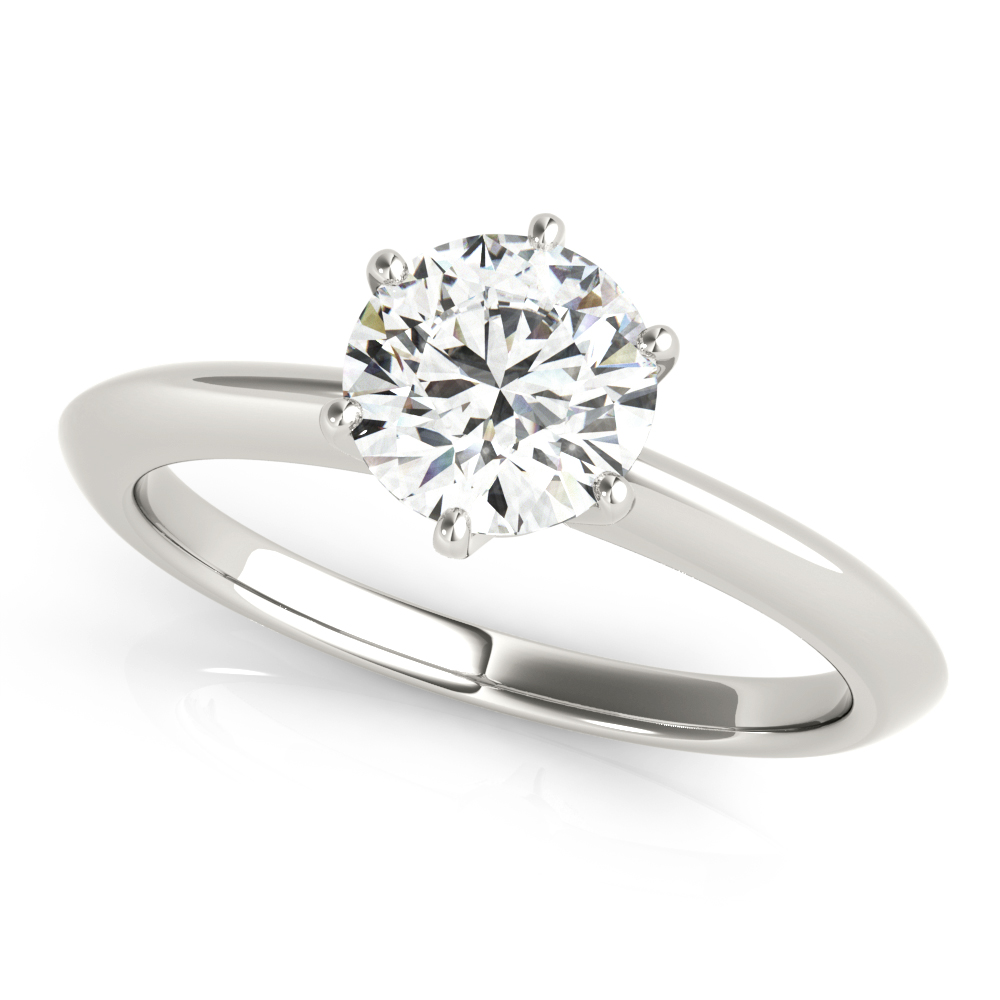
| Six prong solitaire | One stone, six prongs | Holds the stone more securely; looks rounder | More metal over the stone |
| Pavé solitaire | Solitaire with tiny stones along the band | More sparkle along the band | Tiny stones need checking |
| Bezel solitaire | Metal rim around the stone | Best protection; nothing snags | Lets a little less light in |
| Halo, double halo | Center stone framed by small stones | Center looks bigger | Wide head; usually needs a curved band |
| Hidden halo | Halo tucked under the stone, seen from the side | Sparkle from the side, clean top view | Many small stones to maintain |
| Twist solitaire | Band twists up to the stone | Softer, romantic look | Harder to pair with a straight band |
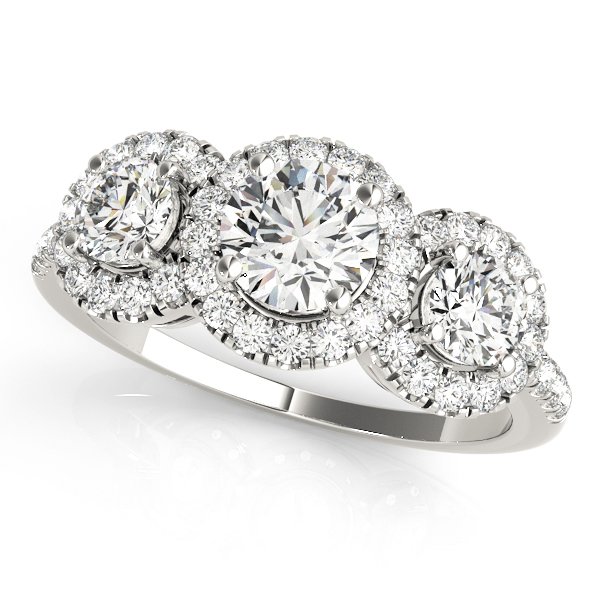
| Three stone, five stone | Center with side stones | Wide, balanced look | Needs a curved or contour band to sit close |
| Toi et moi | Two stones side by side ("you and me") | Unusual and personal | Wide and asymmetric; band fit is tricky |
Step 6: the metal
Yellow gold was the most chosen single metal for 2025 engagement rings at 39% (The Knot). We make every ring in four metals.
| Metal | Good for | Honest downside |
|---|---|---|
| 925 sterling silver | The tightest budget, or a placeholder ring | Softer than gold: scratches, dents and tarnishes over time |
| 14K white gold | A bright white look that makes clear stones pop | Rhodium plated; the plating wears and needs redoing now and then |
| 14K yellow gold | Warm, classic, the 2025 favorite | Shows scratches like any gold |
| 14K rose gold | Pink tone that flatters warm skin | May need polishing to keep its shine |
14K gold is alloyed with other metals, which makes it tougher for daily wear than purer gold. For more, see our metals guide.
Step 7: carat, in millimeters
Carat is weight, not size. What people see is the face size in mm. These are the sizes our ring builder draws for a round and an oval at each carat we offer (diamond-equivalent, so they apply to moissanite and lab-grown diamond).
| Carat | Round | Oval |
|---|---|---|
| 0.5 ct | 5.1 mm | 6.1 x 4.5 mm |
| 0.75 ct | 5.8 mm | 7.0 x 5.2 mm |
| 1 ct | 6.5 mm | 7.7 x 5.7 mm |
| 1.5 ct | 7.4 mm | 8.8 x 6.5 mm |
| 2 ct | 8.0 mm | 9.7 x 7.2 mm |
| 2.5 ct | 8.7 mm | 10.5 x 7.7 mm |
| 3 ct | 9.3 mm | 11.1 x 8.2 mm |
| 4 ct | 10.2 mm | 12.2 x 9.0 mm |
| 5 ct | 11.0 mm | 13.2 x 9.7 mm |
Doubling the weight from 1 ct to 2 ct only adds 1.5 mm across a round. On a size 4 or 5 finger, 1 to 1.5 ct already looks big.
Plan for the wedding band now
A straight band sits flush against a simple solitaire. Halo, three stone and toi et moi heads are wider than the band below them, so a straight band leaves a gap. If a flush fit matters, buy a bridal set made together, or read the wedding band guide before you pick the setting.
See every engagement ring style in your stone, metal and size.
Questions people ask
What should I decide first when buying an engagement ring?
The ring size, then the budget. Size is fixed once the ring is made, and the budget limits every choice after it. Stone, shape, setting, metal and carat follow in that order.
How much should I spend on an engagement ring?
What you can pay without debt. As a market reference, US couples married in 2025 spent $4,600 on average, and lab-grown diamond rings averaged $4,300 (The Knot 2026 Real Weddings Study).
Is moissanite good for an engagement ring?
Yes. It looks like a diamond, sparkles more and costs a fraction, and it is made to last a lifetime of everyday wear. Its rainbow fire shows most in direct sunlight.
Which engagement ring setting is the most durable?
A bezel setting. The metal rim covers the stone's edge, resists chips and does not snag on clothing. Six prongs hold a stone more securely than four.
What if I get the ring size wrong?
We cannot resize, so measure carefully before ordering. A sterling silver or in-stock ring that arrives unworn and does not fit can be returned within 30 days of delivery, then ordered in the right size. 14K gold and platinum rings made to order, engraved and custom pieces cannot be returned.
How big is a 1 carat engagement ring stone?
A 1 ct round is 6.5 mm across. A 1 ct oval is about 7.7 x 5.7 mm, which is why ovals look larger for the same weight.
Sources
- The Knot Worldwide: 2026 Real Weddings Study press release, checked 2026-09-28.
- JCK: Lab-Grown Diamonds Take Command of the Engagement Ring Market, checked 2026-09-28.
- Rapaport: Lab-Grown Taking Over Engagement-Ring Spending (The Knot), checked 2026-09-28.
- GIA Gems and Gemology: Synthetic Moissanite, A New Diamond Substitute, checked 2026-09-28.
- GIA: Diamond, checked 2026-09-28.
- GIA: Sapphire, checked 2026-09-28.
- GIA: Ruby, checked 2026-09-28.
- GIA: Emerald, checked 2026-09-28.
- FTC: In the Loupe, Advertising Diamonds, Gemstones and Pearls, checked 2026-09-28.
- GIA 4Cs: Complete Guide to Engagement Ring Settings, checked 2026-09-28.
- GIA 4Cs: Choosing Between White Gold, Platinum, Palladium, and Silver, checked 2026-09-28.
- GIA 4Cs: Best Ring Material for Everyday Wear, checked 2026-09-28.