Lab diamond 4Cs: how lab-grown diamonds are graded
Lab-grown diamonds are graded on the same cut, color, clarity and carat scales as mined diamonds, and most come with an IGI report that prints full letter grades plus how the stone was grown. GIA stopped giving letter grades to lab-grown diamonds on October 1, 2025, and now labels them only Premium or Standard. For a first ring, the sweet spot is an excellent cut, G or H color and VS2 clarity or better, with the rest of the budget going into size.
- Cut matters most: it controls brightness and sparkle.
- G to J is "near colorless" on GIA's scale.
- Since October 2025, GIA lab reports say only Premium or Standard.
- IGI reports show growth method: CVD or HPHT.
- The FTC requires "lab-grown" or a similar label, clearly shown.
The 4Cs for lab diamonds, in one table
The 4Cs are the four things graders measure. Here is each one, the scale, and where a lab diamond buyer should land.
| C | What it measures | Scale | Sensible target |
|---|---|---|---|
| Cut | How well the facets return light | Excellent, Very Good, Good, Fair, Poor | Excellent (round) or excellent polish and symmetry (other shapes) |
| Color | How much yellow or brown tint | D (colorless) to Z | G or H |
| Clarity | Inclusions inside, blemishes outside | FL, IF, VVS1, VVS2, VS1, VS2, SI1, SI2, I1 to I3 | VS2 or better |
| Carat | Weight (1 ct = 0.2 g) | Points: 100 per carat | What your budget and finger suit |
Cut: the one to spend on
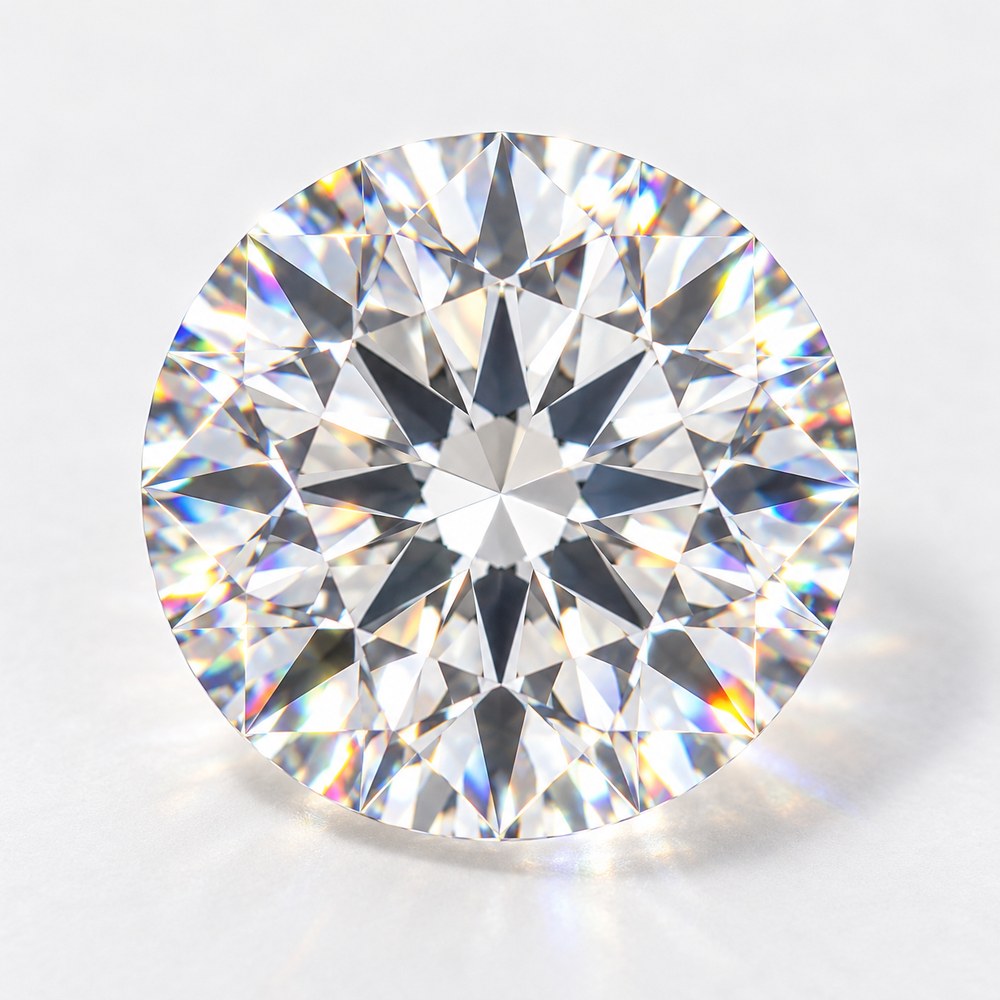
Cut is how well the stone is shaped and polished, not its shape. GIA judges a round diamond on three effects: brightness (white light coming back to you), fire (flashes of rainbow color) and scintillation (the sparkle pattern when it moves). A badly cut stone leaks light out the bottom and looks dark or glassy, no matter how good its color and clarity are.
GIA's cut grade only covers standard round brilliants. For ovals, pears, emeralds and other fancy shapes, look at the polish and symmetry grades and at real photos or video of that exact stone. Both should read Excellent or Very Good.
Color: G or H looks white
Color grades run from D, completely colorless, to Z, a light yellow or brown. GIA splits the scale into five groups: colorless (D to F), near colorless (G to J), faint (K to M), very light (N to R) and light (S to Z). GIA itself says many of these steps are "so subtle as to be invisible to the untrained eye."
That is why G or H is the sweet spot. Face up in a ring, it looks white to almost everyone, and it costs less than D to F. One lab-specific point: GIA notes that CVD diamonds often grow with a brown tint that is removed by heat treatment before cutting. That is allowed, but it should be disclosed (see CVD vs HPHT below).
Clarity: VS2 is enough
Clarity grades how many inclusions (tiny crystals, spots or feathers inside) and blemishes (marks on the surface) a skilled grader sees at 10 times magnification. GIA's definitions:
- FL and IF: no inclusions visible at 10x (IF allows surface blemishes).
- VVS1, VVS2: inclusions "difficult" for a skilled grader to see at 10x.
- VS1, VS2: inclusions "minor," from difficult to somewhat easy to see at 10x.
- SI1, SI2: inclusions "noticeable" at 10x. You may or may not see them without a loupe, depending on the stone.
- I1 to I3: inclusions "obvious" and may affect brilliance.
If a trained grader needs a 10x loupe to find it, you are very unlikely to see it on your hand. That makes VS2 the safe floor. SI1 can work, but only if you see a sharp photo of the actual stone. Lab diamonds have their own kinds of inclusions: HPHT stones can hold tiny metal bits left from the molten metal they grow in, and CVD stones can hold dark specks of graphite.
Carat: weight, not size
A carat is a weight: 0.2 grams, split into 100 points, so a 0.75 ct stone is "75 points." What you see on your hand is the face size in millimeters. These are the round sizes our ring pickers use:
| Carat | Round diameter (mm) |
|---|---|
| 0.5 ct | 5.1 |
| 0.75 ct | 5.8 |
| 1 ct | 6.5 |
| 1.5 ct | 7.4 |
| 2 ct | 8.0 |
| 2.5 ct | 8.7 |
| 3 ct | 9.3 |
Notice that doubling the weight from 1 to 2 ct only adds 1.5 mm across. Carat grows in three dimensions, but you only see two. Every shape is in the carat size chart.
IGI vs GIA reports for lab diamonds
A grading report is the lab's written description of one stone. Two labs matter most for lab-grown diamonds, and since late 2025 they report very differently.
What GIA does now
GIA announced on August 26, 2025 that from October 1, 2025 it would stop using the D to Z and clarity scales on lab-grown diamonds. Its CEO said most lab diamonds "fall into a very narrow range of color and clarity." GIA's Laboratory-Grown Diamond Quality Assessment, still the service listed on its site as of September 2026, gives one of two words:
- Premium: D color, VVS clarity or higher, excellent polish and symmetry, and an excellent cut grade for rounds.
- Standard: E to J color, VS clarity or higher, very good polish and symmetry (good symmetry allowed for fancy shapes), and a very good cut grade for rounds.
Anything below Standard gets no assessment at all. Each assessed stone's girdle (outer edge) is laser-inscribed "Laboratory-Grown" with the assessment number. GIA lab reports issued between 2020 and September 2025 still carry full letter grades.
| Feature | IGI report | GIA quality assessment |
|---|---|---|
| Color | Letter grade, D to Z | Premium (D) or Standard (E to J) |
| Clarity | Letter grade, FL to I3 | Premium (VVS or better) or Standard (VS or better) |
| Growth method | Stated: CVD or HPHT | Not part of the Premium or Standard criteria |
| Treatment | "As grown" or "may include post-growth treatment" | Not part of the Premium or Standard criteria |
| Inscription | Report number, when inscribed | "Laboratory-Grown" plus assessment number |
What this means for you: a GIA "Standard" stone could be E or J color, and those look different side by side. If you shop by grades, an IGI report tells you more. Whatever the lab, check the report number on the lab's own website and match it to the inscription.
CVD vs HPHT in plain words
There are two ways to grow a diamond. Both make real diamond.
- HPHT (high pressure, high temperature) copies the deep earth. Carbon dissolves in molten metal at 1,300 to 1,600 °C and over 870,000 psi, then crystallizes onto a small diamond seed over days to weeks.
- CVD (chemical vapor deposition) builds the diamond layer by layer. A gas is turned into a plasma at about 900 to 1,200 °C and carbon settles onto a seed plate over three to four weeks. GIA says most colorless CVD diamonds on the market were heat-treated after growth to improve their color.
Neither method is better. A CVD stone and an HPHT stone with the same grades look alike. What does matter is disclosure: since 2021, IGI reports say whether a stone is "as grown with no indication of post-growth treatment" or "may include post-growth treatment." Treatment is common for CVD stones and allowed, but you should know about it.
What the FTC says sellers must tell you
In the US, the FTC Jewelry Guides (16 CFR Part 23) set the labeling rules:
- A diamond is crystallized carbon with specific gravity about 3.52 and refractive index 2.42 (section 23.12). A lab-grown diamond meets that definition.
- A lab-made stone named as a gem must be "immediately preceded with equal conspicuousness" by "laboratory-grown," "laboratory-created," "[manufacturer name]-created" or similar (section 23.25). Small print in a footnote does not count.
- "Cultured diamond" is only allowed with a clear lab-grown qualifier (section 23.12).
- Sellers cannot call a manufactured stone "real," "genuine" or "natural" (section 23.27).
- "Flawless" is only allowed for a stone with no flaws at 10x (section 23.13).
So a listing that says "diamond" in big letters and "lab" only in the details is breaking the rules. Every diamond at Azov Diamonds is lab-grown, and we say so.
The sweet spot, and why
| C | Buy | Skip paying for | Why |
|---|---|---|---|
| Cut | Excellent | Nothing: never compromise here | It decides how bright the stone looks. |
| Color | G or H | D to F | GIA: near colorless is hard to tell apart without training. |
| Clarity | VS2 or VS1 | VVS and FL | Inclusions at VS need 10x to find. |
| Carat | Your choice | Nothing | This is what people actually see. |
The logic: pay for what you can see. Cut and size you see every day. The difference between VS2 and VVS1, or between F and G, is only visible to a grader with tools. Ready to compare? See lab diamond engagement rings, or read moissanite vs lab diamond first if you are still choosing a stone. Rings are made to order and cannot be resized, so check the ring size guide before you order.
Questions people ask
Did GIA stop grading lab-grown diamonds?
It stopped giving them letter grades. Since October 1, 2025, GIA's lab-grown quality assessment calls a stone Premium or Standard, and gives no assessment below Standard. Mined diamonds still get full 4Cs grades.
Is IGI as good as GIA for lab diamonds?
For lab-grown stones, IGI now gives you more detail: letter grades for color and clarity, the growth method, and a treatment statement. GIA's two-word result covers a wide range, from E to J color. Whichever lab, verify the report number online.
Is CVD or HPHT better?
Neither. Both produce real diamond, and the grades decide how it looks. Check whether the report says "as grown" or notes post-growth treatment, which is common for CVD.
What clarity is eye-clean for a lab diamond?
VS2 and above is a safe choice, because GIA defines VS inclusions as minor and seen at 10x magnification. SI1 can be eye-clean, but check a clear photo or video of the exact stone.
What color should I get for a lab diamond?
G or H for most rings. GIA calls G to J near colorless and says small color steps are often invisible to the untrained eye. D to F costs more for a difference you are unlikely to notice once it is set.
Do lab-grown diamonds have to be labeled?
Yes. Under the FTC Jewelry Guides, a seller must say "laboratory-grown," "laboratory-created" or similar, as clearly as the word diamond, and cannot call it "natural," "real" or "genuine."
Sources
- GIA (August 26, 2025): Updated Laboratory-Grown Diamond Services to Launch October 1 (Premium and Standard criteria, inscription, CEO quote), checked 2026-09-28.
- GIA: Laboratory-Grown Diamond Services (current services: Premium or Standard quality assessment), checked 2026-09-28.
- National Jeweler: GIA's New Quality Assessment for Lab-Grown Diamonds Is Coming, checked 2026-09-28.
- IGI (January 27, 2021): IGI Lab-Grown Reports Now Indicate Treatments ("as grown" and "may include post-growth treatment"), checked 2026-09-28.
- IGI: Diamond 4Cs Guide, checked 2026-09-28.
- GIA: HPHT and CVD Diamond Growth Processes (temperatures, pressure, CVD brown color and post-growth treatment), checked 2026-09-28.
- International Gem Society: Grading Lab-Grown Diamonds, an Introduction to the Four Cs (HPHT metallic and CVD graphite inclusions, GIA full grading from 2020), checked 2026-09-28.
- GIA: 4Cs Cut (brightness, fire, scintillation; round brilliants only), checked 2026-09-28.
- GIA: 4Cs Clarity (clarity definitions at 10x), checked 2026-09-28.
- GIA 4Cs: Diamond Color Chart, the Official GIA Color Scale, checked 2026-09-28.
- GIA: 4Cs Color ("so subtle as to be invisible to the untrained eye"), checked 2026-09-28.
- GIA: Diamond Quality Factors (1 carat = 0.2 g, 100 points), checked 2026-09-28.
- FTC Jewelry Guides, 16 CFR Part 23 (sections 23.12, 23.13, 23.25, 23.27), checked 2026-09-28.