How to choose a wedding band
Choose a wedding band in this order: how it sits next to the engagement ring (straight or contour), then full or half eternity, then stone size in millimeters, then metal and width. It does not have to match your engagement ring, but the same metal wears better side by side, and a band that sits flush looks intentional. Measure your size first: we make every band to order and cannot resize it.
- Your band does not have to match your engagement ring.
- Halo and three stone rings usually need a contour band.
- Half eternity is easier to wear and costs less.
- A 2 mm stone weighs about 0.03 ct.
- We cannot resize bands, so measure first.
Does your wedding band have to match your engagement ring?
No. There is no rule, and mixing is common. What matters more than matching is three practical things:
- Fit. Can the band sit right against the engagement ring, or does it leave a gap? More on this below.
- Metal wear. Two rings worn together rub all day. Sterling silver is softer than 14K gold, so a silver band next to a gold ring takes the wear and scratches first.
- Scale. A 3 mm stone band next to a 0.5 ct center stone can make the center look small.
Some couples also match the band to their partner's band instead of to the engagement ring. That works too. Think of the rings as a pair you will wear every day for years, not as a single photo.
Straight or contour: will it sit flush?
A straight band is a plain circle. A contour band (we call ours the curved enhancer) bends around the head of the engagement ring so the two rings touch along their whole length. The head is the part that holds the center stone. Whether a straight band fits comes down to how wide the head is and how low it sits.
| Engagement ring | Straight band | Contour band |
|---|---|---|
| Solitaire, six prong solitaire | Usually sits flush | Not needed |
| Bezel solitaire | Often a small gap, the bezel rim is wide | Closes the gap |
| Hidden halo | Usually sits flush | Not needed |
| Halo, double halo | Gap where the halo sticks out | Best fit |
| Three stone, five stone | Gap along the side stones | Best fit |
| Toi et moi, twist solitaire | Gap, uneven | Best fit; often custom |
| Oval, pear, marquise centers | Depends on how low the stone sits | Safer choice for a low setting |
Full eternity vs half eternity
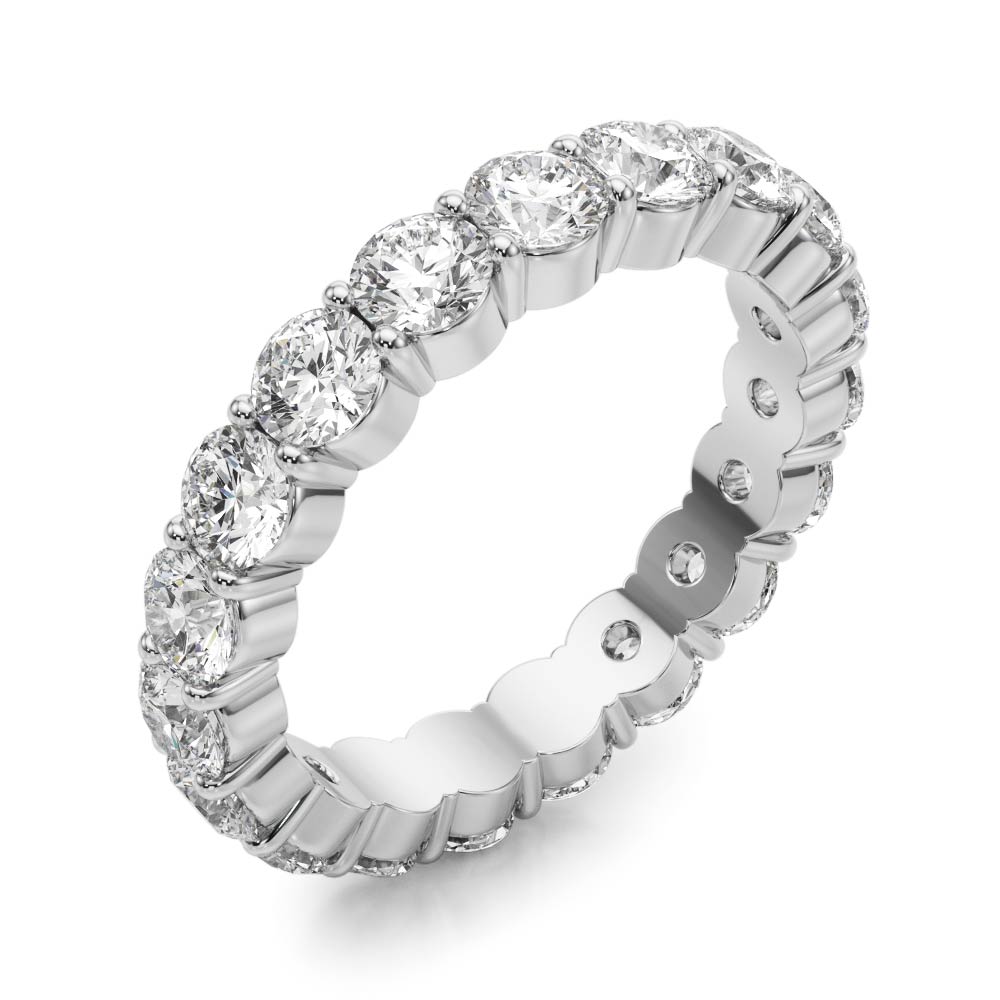
An eternity band has stones set in a row. A full eternity goes all the way around. A half eternity has stones across the top only, with plain metal under your palm.
| Full eternity | Half eternity | |
|---|---|---|
| Look | Sparkle from every angle | Sparkle on top, where people see it |
| Comfort | Stones press between your fingers | Smooth metal where fingers touch |
| Wear | Stones on the palm side knock on desks and weights | Stones stay on top, out of the way |
| Cost | More stones, costs more | Fewer stones, costs less |
| Sizing | Must be exact; stones all around leave no room to adjust | Must be exact here too (we never resize) |
GIA notes that pavé-set bands are harder to resize. With us that does not change anything, because we do not resize any band. It does mean you should measure twice before a full eternity.
Stone sizes in millimeters
Stone bands are sized by the width of each stone. We make them with 1.5, 2, 2.5 or 3 mm stones. The weights below are for a round diamond of that width; moissanite of the same width weighs a little less but looks the same size.
| Stone width | Weight per stone (diamond) | Look | Pairs well with |
|---|---|---|---|
| 1.5 mm | about 0.012 ct | Fine, delicate line of sparkle | 0.5 to 1 ct center, small fingers |
| 2 mm | about 0.03 ct | Classic, the everyday middle | 1 to 1.5 ct center |
| 2.5 mm | about 0.06 ct | Clearly visible stones | 1.5 to 2.5 ct center |
| 3 mm | about 0.10 ct | Bold; can stand alone | 2.5 ct and up, or worn on its own |
The "pairs well with" column is our opinion, not a rule. A useful check: the band's stones should look clearly smaller than the center stone. A 1 ct round center is 6.5 mm across, so even 3 mm stones are less than half its width.
The band styles we make, in plain words
- Full eternity: stones all the way around.
- Half eternity: stones across the top half.
- Shared prong eternity: each prong holds two neighboring stones, so more stone shows and less metal.
- Pavé band: many tiny stones set close together, held by small beads of metal.
- Bezel eternity: each stone sits in its own metal rim. The most snag-free stone band.
- Baguette eternity: long rectangular stones, a clean, modern line.
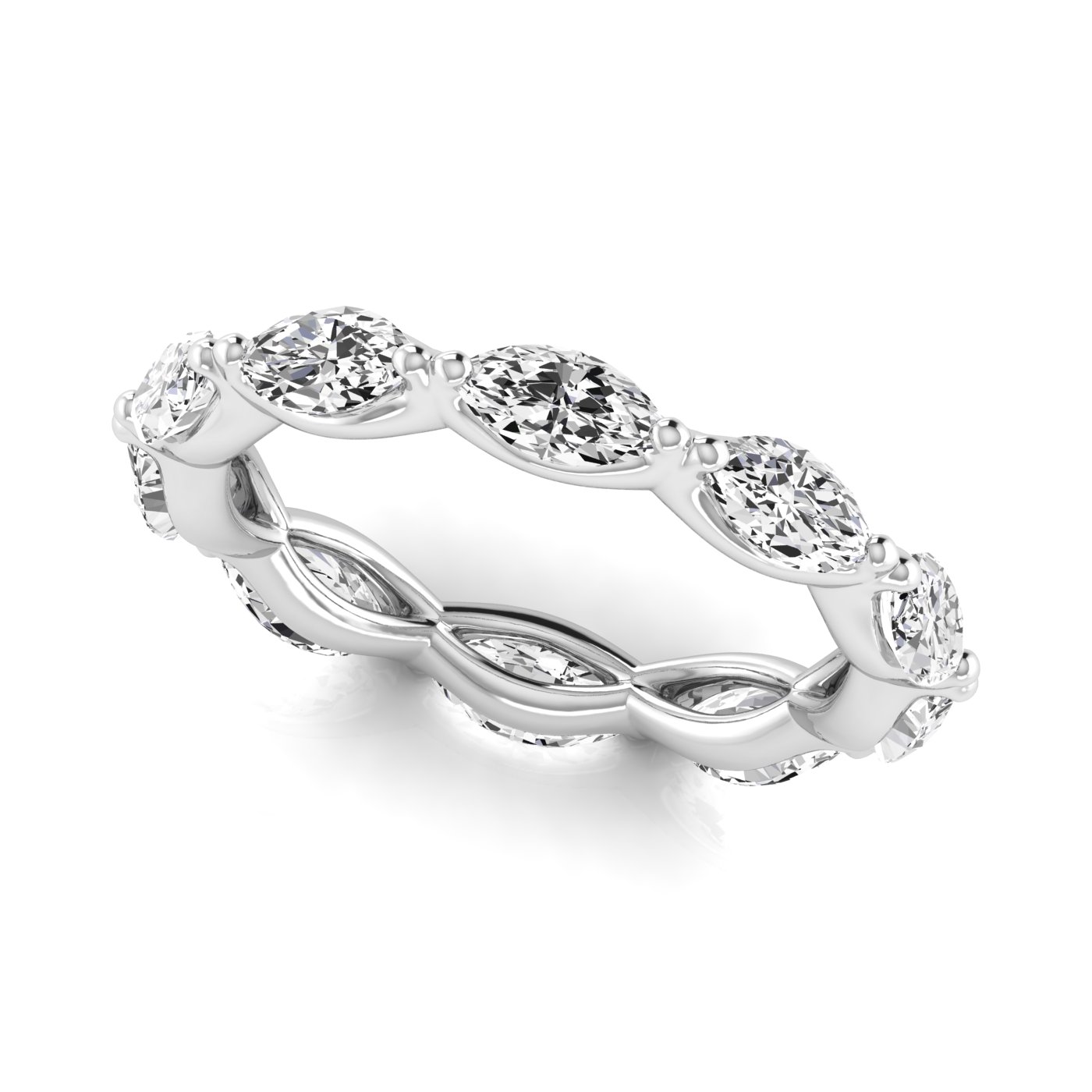
- Marquise band: pointed oval stones, often set at an angle.
- Curved enhancer: our contour band, shaped to wrap around a halo or three stone head.
- Twisted band: a row of stones twisted with a plain strand.
- Graduated band: stones get larger toward the middle.
- Heart band: heart-shaped stones in a row.
See every band style in your stone, metal and size.
Metal: match it, or mix on purpose
We make bands in 925 sterling silver and in 14K white, yellow and rose gold.
| Pairing | How it wears |
|---|---|
| Same 14K gold color | The safest match. Both wear at the same rate. |
| 14K white gold with 14K white gold | Both are rhodium plated. Replate them together so they stay the same white. |
| Two different 14K colors | Both are 14K, so wear is similar. The mixed look is a style choice. |
| Silver next to 14K gold | Silver is softer and tarnishes, so the silver ring shows wear first. |
| Silver with silver | Matches, and is the lowest cost. Expect scratches and polishing. |
More on each metal in our metals guide.
Width and comfort
A stone band is about as wide as its stones plus a little metal on each side. Wider bands feel tighter on the finger than thin ones in the same size, so try a similar width when you measure. Next to a thin engagement ring, a band of about the same width looks balanced. A much wider band can overpower a delicate solitaire.
Men's wedding bands
Our men's ring is a band style set with a row of stones from 1.5 to 3 mm, in US sizes 7 to 13, in silver, 14K gold or platinum. We do not make tungsten or titanium bands. Men's bands rarely need to match anything, so choose on comfort: if you work with your hands or lift, a smaller stone and 14K gold hold up better than silver.
Size and timing
Women's and unisex bands come in US 4 to 10 in half sizes. Inside diameter in mm is 11.63 + 0.8128 x the US size, so a size 6 is 16.5 mm across. We never resize a band: each one is made overseas, and a resize would mean shipping it abroad and back. (After 30 days, we can still arrange a repair or a re-plating, quoted first: you pay what it costs us, plus shipping both ways.) Use our ring size guide, measure late in the day, and use the same size as your engagement ring if it fits well.
Each band is made to order and is at your door within 30 days. Order at least 2 months before the wedding so there is time to reorder if something is off. Sterling silver and in-stock pieces can be returned unworn within 30 days of delivery, with no restocking fee. 14K gold and platinum pieces made to order, engraved and custom pieces cannot be returned.
Questions people ask
Does my wedding band have to match my engagement ring?
No. Matching the metal helps the two rings wear evenly, and a flush fit looks tidy, but mixing styles and metals is common and fine.
What is the difference between eternity and half eternity bands?
A full eternity has stones all the way around. A half eternity has stones across the top only, which is more comfortable, knocks less on hard surfaces and costs less.
Why does my wedding band not sit flush with my engagement ring?
The head of the engagement ring is wider or lower than the band, which is common with halo and three stone rings. A contour band curves around the head to close the gap.
What size stones should my wedding band have?
2 mm is the everyday middle and pairs with a 1 to 1.5 ct center. Go 1.5 mm for a delicate look or a small center, and 2.5 to 3 mm for a bold band or a large center.
When should I order my wedding band?
At least 2 months before the wedding. Each band is at your door within 30 days, and you want time to reorder if the size is wrong, since we cannot resize.
Sources
- GIA 4Cs: Complete Guide to Engagement Ring Settings, checked 2026-09-28.
- GIA 4Cs: Best Ring Material for Everyday Wear, checked 2026-09-28.
- GIA 4Cs: Choosing Between White Gold, Platinum, Palladium, and Silver, checked 2026-09-28.